
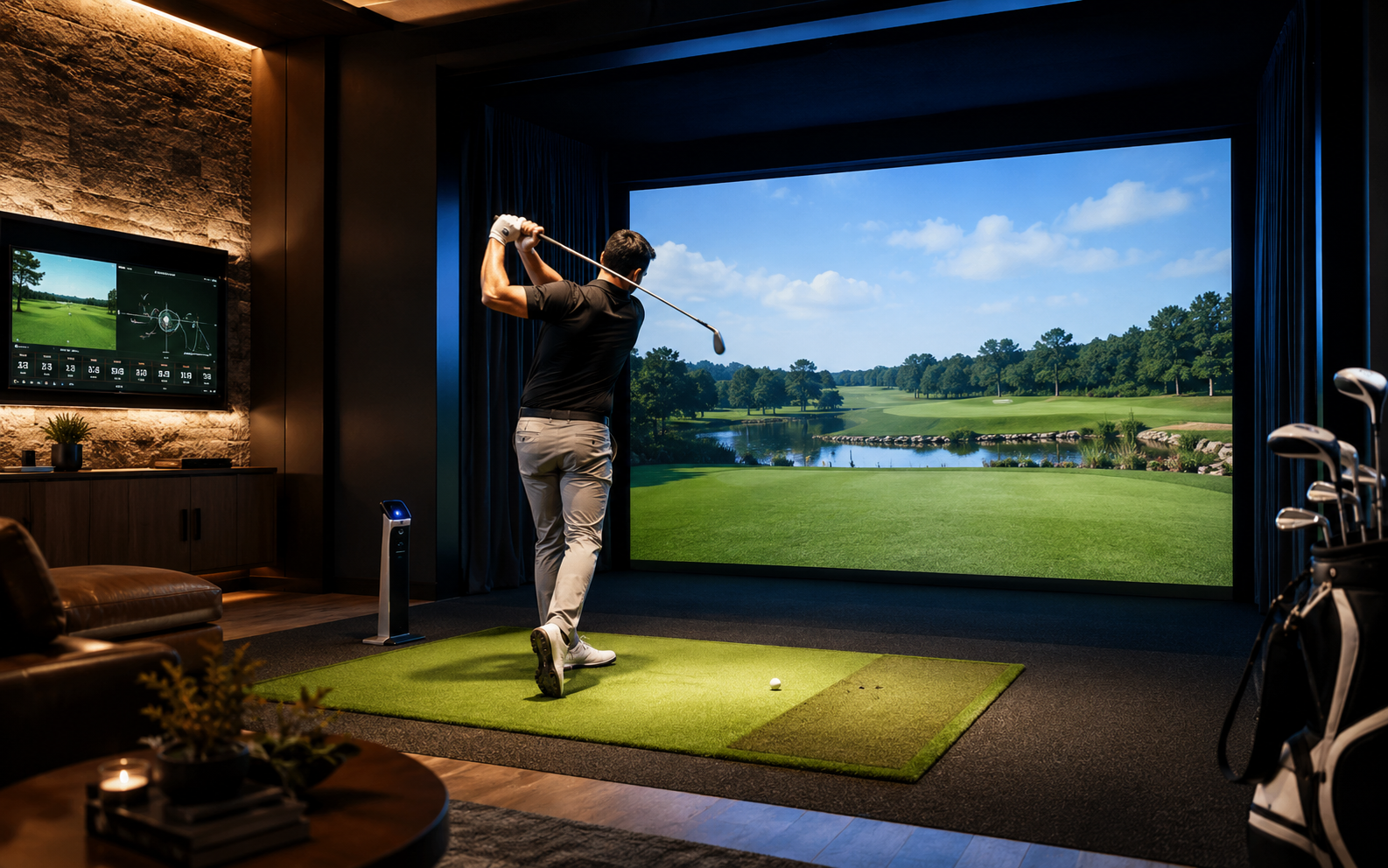
Ten years ago, golf simulators were expensive toys for wealthy enthusiasts with spare rooms. Today, they're a legitimate part of the golf ecosystem. Commercial simulator lounges are opening in cities across the country, home units have dropped below $5,000, and professional players use them daily for off-season training.
How the Technology Works
Modern simulators use a combination of high-speed cameras, radar systems, and infrared sensors to track the club and ball at impact. The best systems capture data points including clubhead speed, ball speed, launch angle, spin rate, and spin axis. That data feeds into software that calculates ball flight and displays it on a projected screen in real time.
Launch monitors like Trackman, Foresight, and Flightscope were originally designed for professional club fitting. When companies started pairing them with simulation software and impact screens, the indoor golf market exploded. The accuracy has improved dramatically too. High-end systems now track ball flight within 2 to 3 yards of actual outdoor performance.
The Social Side of Sim Golf
What surprised the golf industry most wasn't the technology adoption. It was the social angle. Simulator lounges have become the new bowling alleys. Groups of friends rent bays by the hour, order food and drinks, and play virtual rounds on famous courses they'll never visit in person. The history of golf as a social sport stretches back centuries, but simulators are writing a new chapter by bringing the game to urban centers where real courses are scarce.
Companies like Topgolf proved the concept at scale. Their driving range and entertainment hybrid model showed that you didn't need to play 18 holes to enjoy hitting golf balls. Simulators take that idea further by putting the full course experience indoors.
Home Setups Are More Accessible Than Ever
Entry-level home simulators now start around $3,000 for a basic launch monitor, impact screen, and projector setup. That's roughly what a decent set of custom-fitted clubs costs. For golfers in northern climates who lose four to five months of outdoor play each year, the math works out quickly.
The space requirement is the biggest constraint. You need a room with at least 10 feet of ceiling height, 15 feet of depth, and 12 feet of width to swing comfortably with a driver. Garages are the most popular conversion, followed by basements. Some dedicated players have built standalone structures in their backyards specifically for sim golf.
Does It Actually Improve Your Game
Yes, but with caveats. Simulators are exceptional for working on full swing mechanics, testing equipment, and dialing in distances. Hitting hundreds of 7-irons in a session with instant feedback on launch angle and spin rate will absolutely tighten your dispersion patterns. What they can't replicate is the mental game. Reading greens, managing wind, judging lies in the rough, and handling pressure all require real course experience. The best approach combines simulator practice with regular outdoor play. Use the sim to build your swing. Use the course to build your game.